Restructuring your company? Read this before you move a single asset
Moving a property, a business or shares from one entity to another is a disposal for tax purposes. Done the ordinary way, it can trigger capital gains tax, recoupments of allowances claimed, transfer duty, securities transfer tax and VAT — even when no cash changes hands and the same family owns everything before and after. The Income Tax Act has a set of rules built for exactly this. Sections 41 to 47 of the Income Tax Act 58 of 1962 — the "corporate reorganisation rules" — let qualifying restructures happen on a roll-over basis. The tax isn't forgiven. It is deferred: the new owner steps into the old owner's tax cost and dates, and tax is only paid when the asset is later sold outside the structure.
The rules were introduced by the Second Revision Laws Amendment Act 60 of 2001 and apply to transactions from 1 October 2001. They have been amended almost every year since. The latest changes came in the Taxation Laws Amendment Act 5 of 2026, published on 1 April 2026, mainly affecting listed shares and collective investment schemes from 1 January 2026 and 1 January 2027. The family-business rules most SMEs rely on are unchanged.
Used well, they let you: • move a rental property you own personally into a company or under a holding company; • put a holding company on top of your operating companies; • merge two companies into one; • move assets between companies in the same group; • split off a division to a different set of shareholders; • close a dormant subsidiary and bring its assets up to the parent. Used badly, they leave you with the tax bill you were trying to avoid — sometimes years later.
The seven sections at a glance
Section 41 sets the definitions; sections 42 to 47 each cover one type of transaction. Section 41 — Definitions. Defines "group of companies" (70% shareholding), "qualifying interest", "equity share" and other terms the rest rely on. Typical use: Read first — most failed restructures fail on a definition. Section 42 — Asset-for-share. You transfer an asset to a resident company and receive shares in return. Typical use: Moving a property or a sole proprietor's business into a company. Section 43 — Substitutive share-for-share. A company swaps one class of its own shares for another class. Typical use: Changing share classes, e.g. ahead of a B-BBEE or employee scheme. Section 44 — Amalgamation. One company transfers all its assets to another and ceases to exist. Typical use: Merging two companies in a group into one. Section 45 — Intra-group. One group company transfers an asset to another group company. Typical use: Moving property out of the trading company into a property company. Section 46 — Unbundling. A company hands the shares it holds in a subsidiary to its own shareholders. Typical use: Splitting a division off to a different owner or family branch. Section 47 — Liquidation distribution. A subsidiary distributes its assets to its holding company and is wound up or deregistered. Typical use: Closing a dormant subsidiary and moving its assets up.
How each section works, with an example
All figures below are illustrative. Rates used: capital gains for individuals include 40% at a top marginal rate of 45% (effective 18%); for companies 80% at 27% (effective 21.6%).
Section 42 — asset-for-share
You transfer an asset to a South African resident company and the company pays you in shares. The gain rolls over: you are treated as having sold the asset at its tax cost, and the company takes over that cost and the original acquisition date. Key conditions: • The asset's market value must be at least equal to its base cost — you can't roll over a loss. • Immediately after the transfer you must hold a qualifying interest — broadly at least 10% of the company's equity shares and voting rights (unlisted company). • Any consideration other than shares (cash, a loan account) is taxed now as a normal sale. • A bond the company takes over is relief-friendly only if it is a "qualifying debt" — broadly, debt incurred more than 18 months before the transfer, or used to buy the asset in the first place.
Example. Johan owns a flat in his own name. He bought it for R1.2 million; it is now worth R3 million. He transfers it to Johan Properties (Pty) Ltd for 100% of its shares. • Without section 42: gain of R1.8 million, 40% included = R720 000 taxable, about R324 000 in CGT at 45%. • With section 42: no CGT now. The company holds the flat at a base cost of R1.2 million. Tax is paid only when the flat is sold, and then at company rates. Watch: if Johan sells his shares within 18 months, or the company sells the flat within 18 months, anti-avoidance rules can claw back or ring-fence the gain.
Section 43 — substitutive share-for-share
A shareholder gives up equity shares in a company in exchange for a different class of equity shares in the same company. The new shares inherit the old shares' base cost and dates, so the swap is tax-neutral. Example. Botha Holdings converts the founder's ordinary shares into A-ordinary shares to make room for B-shares for a new employee trust. No capital gain arises on the conversion.
Section 44 — amalgamation
One company (the amalgamated company) transfers all its assets to a resident resultant company, and its shareholders receive shares in the resultant company. The amalgamated company must then take steps to end its existence — generally within 36 months. Example. Two sister companies, Alpha Plumbing and Beta Plumbing, merge into Alpha. Beta's assets move to Alpha at their existing tax values; Beta's shareholders receive Alpha shares; Beta is deregistered.
Section 45 — intra-group transaction
One company transfers an asset to another resident company in the same group — broadly 70% common shareholding. Payment is usually a loan account, not equity shares (equity shares would make it a section 42 deal). The receiving company steps into the seller's tax cost and dates. Key anti-avoidance rules: • De-grouping charge: if the two companies leave the group within six years while the asset is still held, the deferred gain is taxed. • 18-month rule: a sale of the asset within 18 months ring-fences the pre-transfer gain against assessed losses. • Loan accounts: the loan created to pay for the asset has a nil base cost in the seller's hands.
Example. OpCo (Pty) Ltd owns its factory. A new PropCo, also 100% held by the same HoldCo, buys the factory on loan account. No CGT or recoupment arises now, and the factory sits away from trading risk.
Section 46 — unbundling
A company distributes the equity shares it holds in a subsidiary to its own shareholders, in proportion to their holdings. For an unlisted subsidiary, the unbundling company must hold more than 50% of its equity shares. Shareholders split their base cost between the old and the unbundled shares by market value. Example. Family HoldCo owns 100% of a farming company and 100% of a logistics company. One brother wants the farm, the other the trucks. HoldCo unbundles the logistics company to its shareholders as a first step, so each line can later be owned separately.
Section 47 — liquidation distribution
A subsidiary distributes all its assets to its holding company (a group company, 70%+) and is then liquidated, wound up or deregistered. Steps to close it must generally be taken within 36 months. The holding company takes over the assets at their existing tax values. Example. A dormant subsidiary still holds a vacant stand. It distributes the stand to its parent and is deregistered — without CGT on the stand or on the shares in the subsidiary.
Other taxes the rules also switch off. A transaction that qualifies under these sections can also be relieved from other taxes, each subject to its own conditions: • Transfer duty — Transfer Duty Act, section 9(1)(l). • Securities transfer tax — STT Act, section 8(1)(a). • VAT — VAT Act, section 8(25): the seller and buyer are treated as one person where both are vendors.
Worked example: one family group, two roll-over steps
Johan owns a rental flat in his own name and 100% of OpCo, which owns the factory it trades from. He wants a holding company on top and the property ring-fenced away from trading risk.
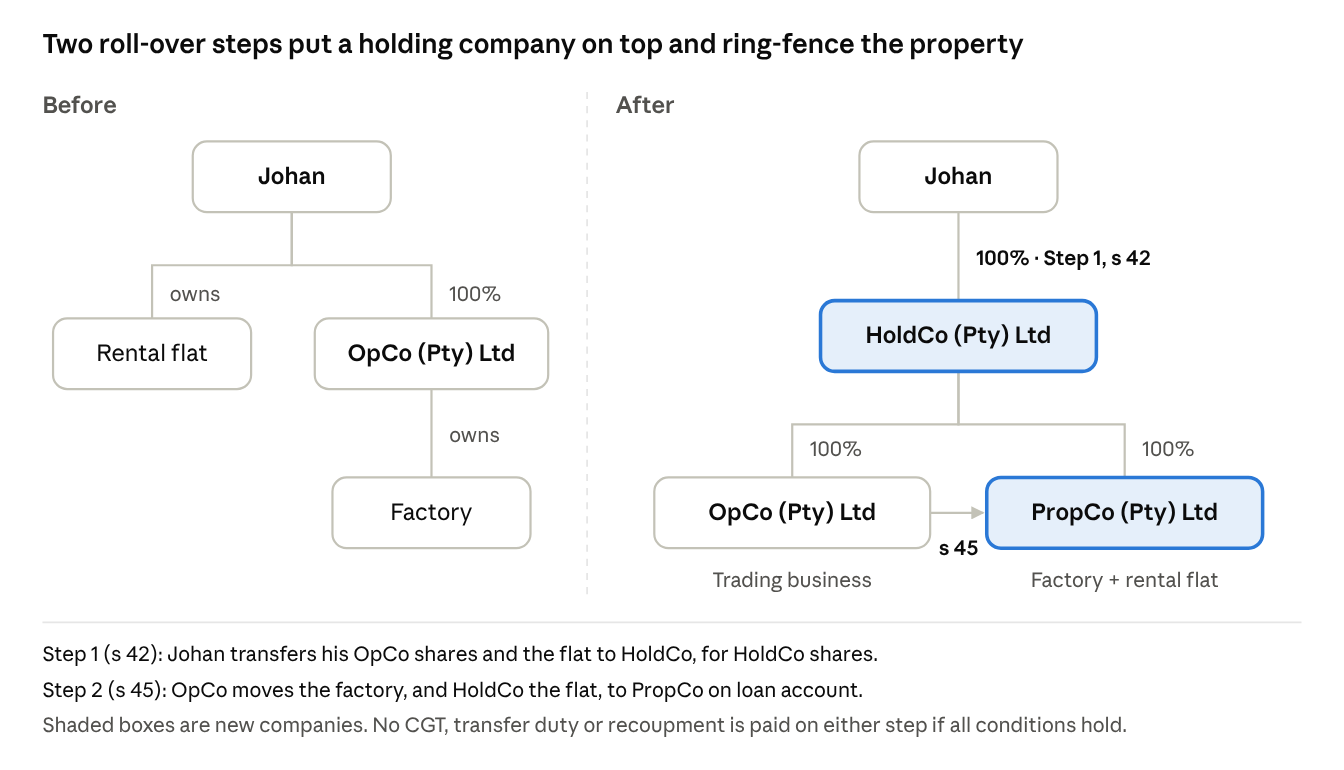
Step 1 uses section 42 and step 2 uses section 45, so neither triggers tax now. The order matters: HoldCo must exist and hold at least 70% of both OpCo and PropCo before step 2, or section 45 doesn't apply. Moving the flat on again soon after step 1 also engages the 18-month rules, so the timing is planned up front.
What SARS has actually ruled: five practical examples
SARS publishes binding private rulings (BPRs) on real restructures. A BPR binds SARS only towards the applicant, so no one else may rely on it — but these show how the sections are applied in practice, and where a plan falls short. BPR 418 (opens in a new tab) (18 Nov 2025) — sections 42, 24BA, VAT s 11(1)(e), Transfer Duty s 9(1)(l). What was done: A sole proprietor moved his whole timber farm (land, standing timber, buildings, movables) into his own close corporation as a going concern, taking an increased member's contribution and no loan account; he keeps working in the business full-time. What SARS ruled: Qualifies as an asset-for-share transaction. Assets pass at base cost; no recoupment on the plantation or allowance assets; s 24BA doesn't apply; no transfer duty on the public officer's sworn declaration; zero-rated for VAT except the residential buildings; no donations tax. BPR 399 (opens in a new tab) (Feb 2024) — sections 42, 18-month rule. What was done: A sole proprietor moved his business, including an aircraft, into his company under s 42. The company sold the aircraft within 18 months and bought a replacement, claiming replacement-asset relief. What SARS ruled: The 18-month rule had nothing to bite on: replacement-asset relief meant no gain or recoupment arose on the early sale, so nothing could be ring-fenced. The rule can't tax a hypothetical gain.
BPR 388 (opens in a new tab) (16 Jan 2023) — section 45(4) de-grouping. What was done: A group that had done five s 45 transfers in the previous six years wanted to restructure and distribute a sub-holding company before selling the top company. What SARS ruled: Mixed result. Some earlier transfers triggered no de-grouping charge because the transferee stayed in the group; others did, because the companies holding the assets left the group. Base costs were stepped up by the charge. BPR 210 (opens in a new tab) (11 Nov 2015) — sections 47 then 44. What was done: A subsidiary distributed all its assets to its parent and was wound up within 36 months (s 47); the parent then merged into a sister company under a Companies Act s 113 amalgamation, its shareholders taking shares in the sister (s 44). What SARS ruled: Both steps qualified. No recoupment or capital gain at either level; shareholders' new shares inherited the old base cost and date; the share distribution was free of dividends tax. BPR 419 (opens in a new tab) (18 Nov 2025) — section 44. What was done: A foreign-owned group tried to collapse three SA companies into one: the middle company would receive its subsidiary's assets (s 47), then "amalgamate" into that same subsidiary by handing back the subsidiary's own shares. What SARS ruled: Does not qualify. The only asset transferred was the subsidiary's own shares, which are extinguished when the subsidiary receives them. Nothing merges, so there is no amalgamation.
Three lessons from the rulings: 1. The textbook s 42 deal works (BPR 418): a going-concern transfer, shares only, no loan account, the owner staying in the business, and the VAT and transfer duty exemptions following. 2. Timing rules bite on substance, not form (BPR 399 and 388): an early disposal with no actual gain isn't punished, but a company leaving the group within six years of a s 45 transfer usually is. 3. Each step must do what the section says (BPR 419): a liquidation followed by a merger is a well-worn path, but a merger where the only asset is the other company's own shares isn't a merger at all. The order of steps and what each company holds at each point decides whether relief applies.
Where restructures go wrong
Most failed roll-overs fail on a detail, not the big idea. The ones we see most: 1. Trusts and individuals in the wrong place. Section 45 and section 47 only work between companies. A trust or a person can only use section 42 (and section 43 or 46 as shareholder). 2. The 18-month windows. Selling the asset or the shares too soon after the roll-over can undo the relief or ring-fence the gain. 3. The six-year de-grouping charge. Selling PropCo out of the group within six years of a section 45 transfer can bring the deferred gain back. 4. Value mismatches. If the shares issued are worth more or less than the asset, section 24BA can create a deemed dividend or a deemed capital gain. 5. Bonds and loan accounts. A bond taken out shortly before the transfer may not be a qualifying debt, so its assumption is taxed. Loan accounts created under section 45 start at nil base cost. 6. Forgetting the other taxes. Dividends tax on distributions, VAT registration of the receiving company and transfer duty all need their own check. 7. Missing paperwork. Each section has conditions that must appear in the agreement, the resolutions and the share register — and in the right order. Steps to deregister under sections 44 and 47 must actually be taken. 8. Assuming relief is optional. Relief applies automatically when the requirements are met. If you don't want it, sections 42, 44, 45 and 47 let the parties opt out in writing.
How Lawvero helps
A roll-over is only as good as its paper trail. Lawvero prepares the full document set for your restructure, at a fixed fee quoted upfront once we've seen the structure: • a step plan and organogram of the before-and-after structure; • asset-for-share, sale or distribution agreements drafted to the section's requirements; • board and shareholder resolutions, share certificates and updated securities registers; • MOI amendments where share classes change; • deregistration steps for sections 44 and 47.
Request a restructuring quote: email office@lawvero.co.za or WhatsApp 065 764 3430 with a short description of your current structure and what you want to achieve. You can also use the tax restructuring page on lawvero.co.za.
Frequently asked questions
Does roll-over relief mean I never pay the tax? No. It defers the tax. The receiving entity inherits your tax cost, so the gain is taxed when the asset is eventually sold outside the structure. Can I move my rental property into a company without paying CGT? Often, yes — through section 42, if you take shares in return, hold at least 10% afterwards and the bond on the property is a qualifying debt. Can I move an asset from my company into my family trust under these rules? No. Sections 42 to 47 move assets into or between companies. Moving assets to a trust is an ordinary disposal and needs its own planning. Is transfer duty payable when property moves under section 42 or 45? A qualifying transaction is generally exempt from transfer duty, but the exemption has its own conditions and must be checked per deal. Do I need a SARS ruling? Not usually. The rules apply automatically when the requirements are met. An advance tax ruling is worth considering for large or unusual transactions.
Lawvero provides document preparation services and does not provide legal or tax advice. This article is general information and not advice on any specific transaction.